Random Animal Generator Wheel 2026
Random Animal Generator Wheel — Spin to Discover the Animal Kingdom. Every spin is a new adventure!
What Is a Random Animal Generator Wheel?
Picture a classic spinning wheel — the kind you'd see at a game show or a school fair — except instead of prizes, every single slice holds a different animal. A flamingo. A goblin shark. A Tibetan fox. A pistol shrimp. You click spin, the wheel turns with satisfying momentum, slows down, and lands on something you probably never would have searched for on purpose.
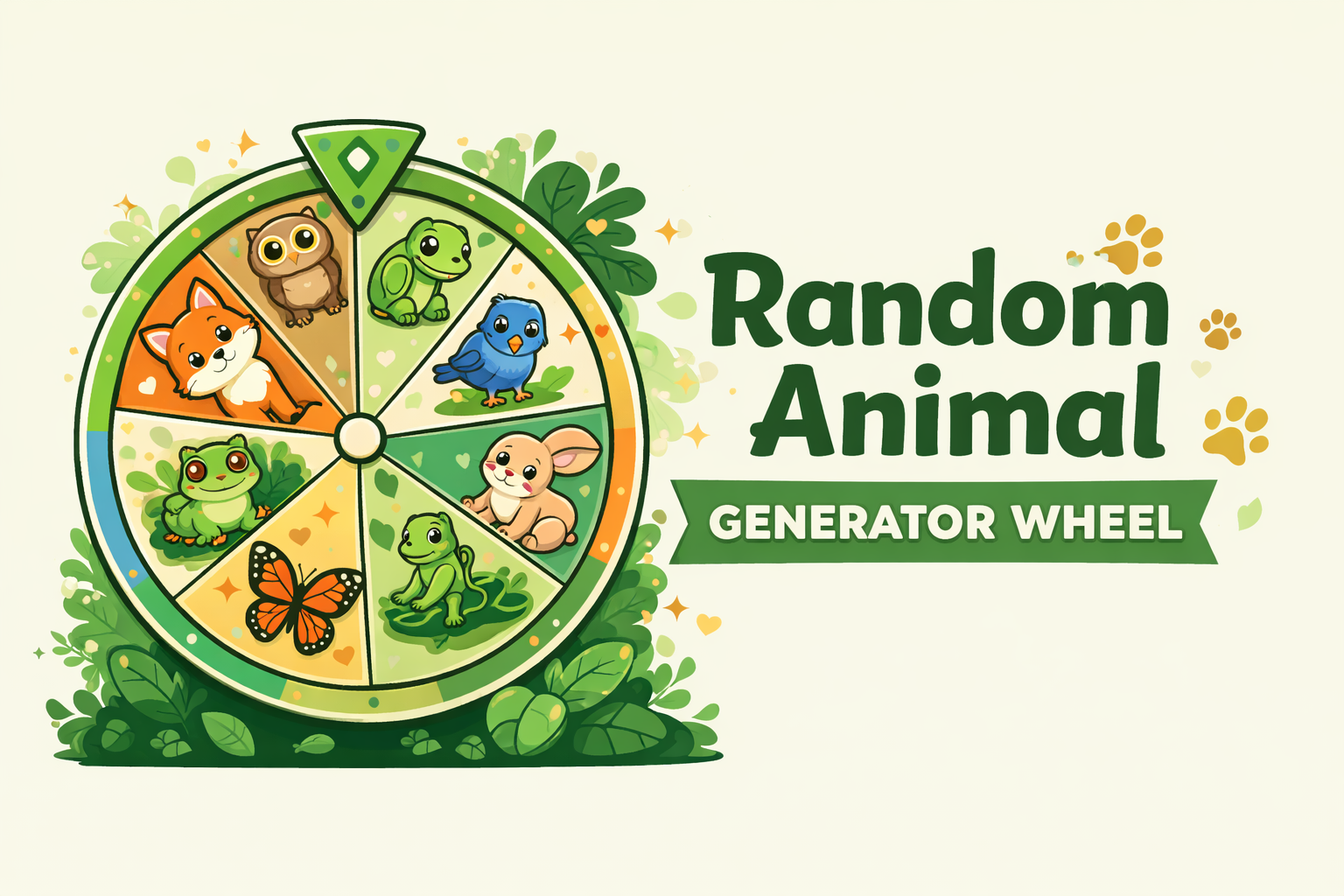
That's a random animal generator wheel in a nutshell. It's a free, browser-based interactive tool that combines the visual thrill of a spinning wheel with the curiosity of wildlife discovery. Unlike a standard list-based animal picker, the wheel format adds a layer of anticipation — you watch it spin, you wonder where it's going to land, and that half-second of suspense is genuinely fun every single time.
It's deceptively simple. But people — kids, teachers, artists, trivia lovers, and wildlife enthusiasts — come back to it again and again, and there's a real psychological reason for that.
How a Random Animal Generator Wheel Is Different From a Regular Generator
You might be thinking — isn't it the same thing as a regular random animal generator, just with a wheel graphic slapped on top? Not quite. The wheel format actually changes the experience in meaningful ways.
With a standard generator, you click a button and a result appears. It's instant and clean. But the wheel adds what UX designers call perceived agency — you're not just receiving a result, you're watching a process unfold. The spinning animation, the gradual deceleration, the pointer ticking against the slices — all of it makes the outcome feel earned rather than just delivered.
There's also something inherently social about a wheel. A list-based generator is generally a solo experience. A spinning wheel naturally draws people around it — in classrooms, at game nights, at family gatherings. You watch it together. You guess. You react. That's a fundamentally different kind of interaction.
Who Uses a Random Animal Generator Wheel (And Why They Keep Coming Back)
Kids and Families
For kids, the spinning wheel format is almost irresistible. There's something about watching it turn that bypasses any resistance to learning and replaces it with pure anticipation. Parents who want to make bedtime wildlife conversations more interesting, or homeschool families building nature study into their week, often land on an animal wheel spinner as a low-effort, high-engagement solution. You spin it, you get an animal, you look it up together. That's the whole activity — and somehow it works brilliantly.
Teachers and Classrooms
The classroom use case for a random animal wheel is genuinely strong. The random element is doing a lot of pedagogical work — it prevents students from always defaulting to lions, dogs, and sharks, and it creates an equal-opportunity entry point for discussion. Every student gets an animal by the same fair, chance-based process. No favorites, no complaints.
Common classroom uses include daily warm-up discussions, biology assignment topics, creative writing prompts, animal charades, and guess-the-animal quiz rounds where the wheel is spun and students compete to name the creature before it's revealed.
Artists and Illustrators
The random animal wheel has a dedicated following in the art community — and for good reason. Many illustrators and character designers use daily drawing challenges to improve their skills, and the challenge works best when you have no say in what you're drawing. A wheel removes that choice entirely. You spin, you get a hagfish or a mandrill or a Dumbo octopus, and now you have to figure out how to make it look good on paper. That constraint breeds creativity.
Writers and Game Developers
Writers use it for character inspiration, setting building, and plot prompts. A random animal generator wheel is particularly useful for fantasy and science fiction writers who need to design creatures that feel grounded in real biological logic. Game developers use it similarly — generating fauna for world-building, designing monster abilities based on real animal behaviors, or quickly populating an ecosystem for a new game environment.
Trivia Night Hosts
A spinning wheel is a natural fit for trivia because it adds showmanship. Cover the animal name, show the image when the wheel lands, and challenge your table to identify it. Or read out facts about the animal while spinning and pause to ask who can name it first. The visual drama of the wheel turning heightens the game experience in a way that just reading from a list doesn't.
Creative Activities Using the Animal Wheel Spinner
For the Classroom
- Daily Animal Fact Challenge — Spin the wheel at the start of class. The first student to share one true fact about the animal gets a point.
- Adaptation Investigation — Generate a random animal and challenge students to research and present its top three survival adaptations.
- Build-a-Food-Chain — Spin five animals. Students must construct a plausible food chain or food web from those five.
- Animal Art Sessions — Weekly drawing challenge based on whatever the wheel produces.
- Conservation Status Debate — Filter the wheel to produce only endangered or critically endangered species. Students research what's threatening their assigned animal.
For Game Nights
- Animal Charades — Spin the wheel to assign animals for charades. No sounds allowed.
- Wheel of Trivia — The host spins. Contestants must guess the animal before the reveal.
- Animal Bingo — Generate 25 random animals before the game starts, arrange them in a 5x5 grid, then take turns spinning and marking.
- Speed Round Identification — Spin rapidly and challenge players to shout out one fact about each animal before the next spin.
For Artists
- 30-Day Animal Drawing Challenge — Spin once per day for 30 days. Draw whatever you get.
- Fantasy Hybrid Design — Spin twice. Combine the two animals into a single mythological hybrid creature.
- Animal Emoji Grid — Spin 16 times, illustrate each result in a small square. Arrange into a 4x4 grid poster.
For Writers
- Species-Specific Narrator — Spin the wheel and write a short scene entirely from that animal's perspective.
- Animal vs. Animal Conflict — Generate two animals that would never naturally meet. Write the scene of their encounter.
- Build a World — Spin 10 animals and use them as the only fauna in a fictional ecosystem.
Animal Categories You'll Encounter on a Good Wheel
A comprehensive random animal wheel covers the full range of vertebrate and invertebrate life. Here's what you should expect to encounter across a well-stocked tool:
- Mammals — Snow leopards, capybaras, star-nosed moles, binturongs, and wolverines alongside the more familiar dogs, dolphins, and elephants.
- Birds — Toucans, secretary birds, kakapos, birds-of-paradise, shoebill storks, and frigatebirds alongside sparrows and pigeons.
- Reptiles — Komodo dragons, thorny devils, leatherback sea turtles, flying lizards, and saltwater crocodiles.
- Amphibians — Axolotls, glass frogs, Chinese giant salamanders, purple frogs, and hellbenders.
- Marine Animals and Fish — Anglerfish, cuttlefish, mantis shrimp, leafy sea dragons, barreleye fish, giant isopods, and narwhals.
- Insects and Invertebrates — Orchid mantises, goliath beetles, atlas moths, peacock spiders, and trap-door spiders.
- Endangered and Critically Threatened Species — Vaquita, Amur leopard, saola, Sumatran orangutan, black-footed ferret, Javan rhino.
Why the Spinning Wheel Format Works So Well Psychologically
This is worth understanding, because it explains why an animal wheel spinner gets used more than a simple list-based generator, even when the underlying animal database is identical.
The spinning wheel activates what psychologists call variable reward anticipation — the same mechanism that makes scratching a lottery ticket more compelling than just being handed the result. The process of waiting to find out is neurologically rewarding in itself. The gradual deceleration of the wheel, the ticking sound of the pointer against each slice, the moment it finally settles — all of that builds micro-tension that makes the reveal satisfying.
In educational contexts, this matters because engagement is the primary barrier to learning. A student who is genuinely curious about what the wheel is going to land on is primed to absorb information about that animal in a way that a student handed an assigned reading simply isn't. The wheel earns the attention before the content has to.
Frequently Asked Questions
Q: What is a random animal generator wheel?
A: It's a free online interactive spinning wheel that randomly selects an animal from a database when you click spin. The wheel format adds visual anticipation and a social element that makes it more engaging than a simple button-click generator. Most tools include animal photos, facts, habitat info, and conservation status alongside each result.
Q: Is the animal spinning wheel truly random?
A: A well-built animal wheel uses cryptographically secure randomization rather than standard pseudo-random algorithms. This means the result is genuinely unpredictable and impossible to influence or rig.
Q: Can I use the animal wheel for classroom activities?
A: It's one of the best classroom use cases. Teachers use it for daily warm-ups, creative writing prompts, biology project assignment, charades, trivia, and conservation discussions. The random element ensures every student gets a fair, unpredictable animal to work with.
Q: Is a random animal wheel good for kids?
A: It's excellent for kids. The spinning animation is inherently engaging, the surprise element maintains attention, and the wildlife discovery is genuinely educational.
Q: Can I use the animal wheel as a drawing challenge tool?
A: Absolutely. The daily animal drawing challenge is one of the most popular uses in the art community. Spin once a day, draw whatever you land on. The randomness pushes you to practice species and anatomies you'd never voluntarily choose, which accelerates artistic development.
Q: What's the difference between a random animal wheel and a random animal generator?
A: The core function is the same — both randomly select an animal from a database. The wheel format adds a visual spinning animation that creates anticipation and makes the experience more social and game-like.
Final Thoughts — The Spinning Wheel Is the Right Format for Animal Discovery
There are lots of ways to learn about animals. Documentaries, textbooks, zoo trips, field guides. All of them are valuable in their own contexts. But a random animal generator wheel does something none of those can do on a Tuesday afternoon with five minutes to spare: it makes the unknown exciting.
The spin is the hook. The anticipation is the doorway. Whatever lands on that pointer — whether it's a binturong, a thorny devil, or a Dumbo octopus — is now your animal for the next few minutes, arrived at fairly, unexpectedly, and with just enough drama to make you care.
Spin once. See what you get. You probably won't stop at once.
🔗 Related Resources
- Random Animal Generator — Generate animals with a click
- About This Tool — How the generator works
- Contact Us — Suggest animals or send feedback
🌍 External Wildlife Resources
- iNaturalist — Citizen science wildlife platform
- WWF — World Wildlife Fund — Wildlife conservation
- IUCN Red List — Conservation status database
- Wikipedia: Animal — Encyclopedia overview of the animal kingdom